Executive Management Leadership Ver11. “Kindness and Strictness in Management Depend on Preconditions”
- Shigenori Tanaka

- 4月28日
- 読了時間: 3分
Apr 28, 2026
Thank you for reading again.
Today, I would like to share some thoughts — based on my own experience — about kindness and strictness in management. Some subjective views may be included, and I appreciate your understanding.
■ Introduction
The “kindness” and “strictness” of a leader are often discussed in overly simple terms. In reality, I believe both have two dimensions: interpersonal and treatment (working conditions). The balance between these two axes significantly shapes a company's management style.
As a note,
the “kindness” and “strictness” on the interpersonal axis do not refer to tone of voice or manner of speaking, but rather to how leaders engage with employees and the level of expectations they place on them.
Through my involvement with multiple organizations, I have seen how this balance influences employee growth, retention, and organizational stability.
Among those experiences, one particular leader I worked with within the same corporate group left a strong impression on me.
■ Kind to People, Strict in Treatment (A: Structure-Oriented Style)
This leader was exceptionally kind in interpersonal interactions. He spoke gently to employees and never applied unnecessary pressure.
On the other hand, he was strict in terms of treatment — compensation and benefits were modest. But there was a clear reason behind this strictness:
He did not expect significant growth from each employee.
As a result:
KPIs were limited and focused on a single responsibility
Employees were assigned only what they were good at, combining individual strengths like pieces of a jigsaw puzzle
A large workforce allowed for rotation
Multi‑skilling occurred naturally
Growth happened as a “by‑product”
Employees could concentrate without confusion, and employee retention remained high while motivation stayed strong.
■ Strict to People, but Considerate in Treatment (B: Development-Oriented Style)
My own style was the opposite. I tended to expect growth from employees.
Therefore:
KPIs were multi-dimensional and designed with development and multi-skilling in mind
Employees were encouraged to take on challenges outside their comfort zone
I emphasized expanding their scope of responsibility
At the same time, I tried to be as considerate as possible in terms of treatment
Some employees grew significantly under this approach. However, the workload was high, and it was not an ideal environment for everyone.
This was a development-oriented style — a style that places expectations on employees.
■ The Metric Japan HR Matrix: Kindness and Strictness Viewed Through Two Axes
From experience, I have come to believe that kindness and strictness consist of two axes: interpersonal and treatment (working conditions).
Organizing management styles along these two axes results in what I call the Metric Japan HR Matrix, which categorizes leadership approaches into four distinct types:
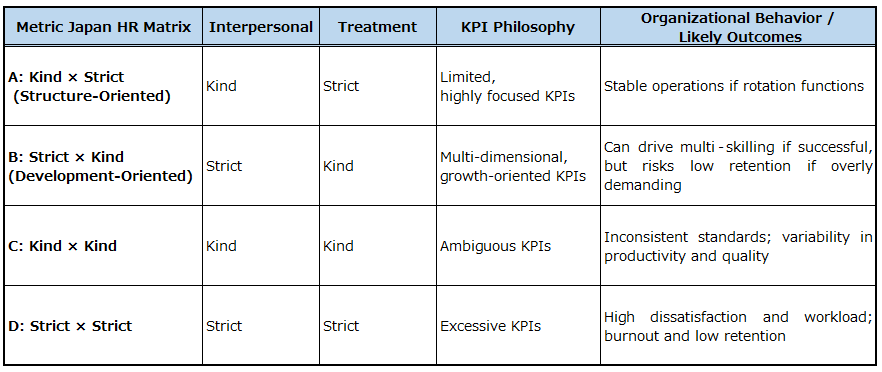
Styles C and D carry significant operational risks. In practice, only A or B can function sustainably.
■ Preconditions Determine the Management Style
The structure-oriented style (A) worked well because that company had a sufficiently large workforce.
Rotation was possible
Strengths could be combined
Weaknesses could be avoided
Expertise could be shared across departments
In contrast, the company I managed was a small, lean organization. Rotation was nearly impossible.
Therefore, I had no choice but to adopt the development-oriented style (B).
It is not about which is better. Company size, structure, and required expertise — these preconditions determine which style is appropriate.
■ Conclusion: A May Be Ideal, but B Can Be the Optimal Choice Depending on Preconditions
If the preconditions are met, the structure-oriented style (A) is highly effective. It keeps fixed costs low, maintains morale, and enables results without placing heavy expectations on employees.
However, not every company can choose this style.
When the preconditions — such as workforce size, specialization, and rotation feasibility — are not met, the development-oriented style (B) becomes the realistic and often optimal choice.
That said, even within the development-oriented approach (B):
Overloading employees with KPIs creates problems
Expecting the same level of growth from everyone is a mistake
Employees differ in skill level, motivation, and potential. Assigning wide and high‑level KPIs uniformly often leads to overload and dissatisfaction.
Ultimately, the appropriate balance of kindness and strictness depends on the preconditions each organization faces. And aligning expectations and operations with those preconditions is what supports organizational stability and growth.
■ Contact
I provide practical support in areas such as organizational design, HR systems, evaluation and compensation frameworks, KPI design, PMI, and management infrastructure development. My approach is grounded in real operations, balancing both management and on-site perspectives.
For inquiries: info@metricjapan.com
■ TAGS


コメント